
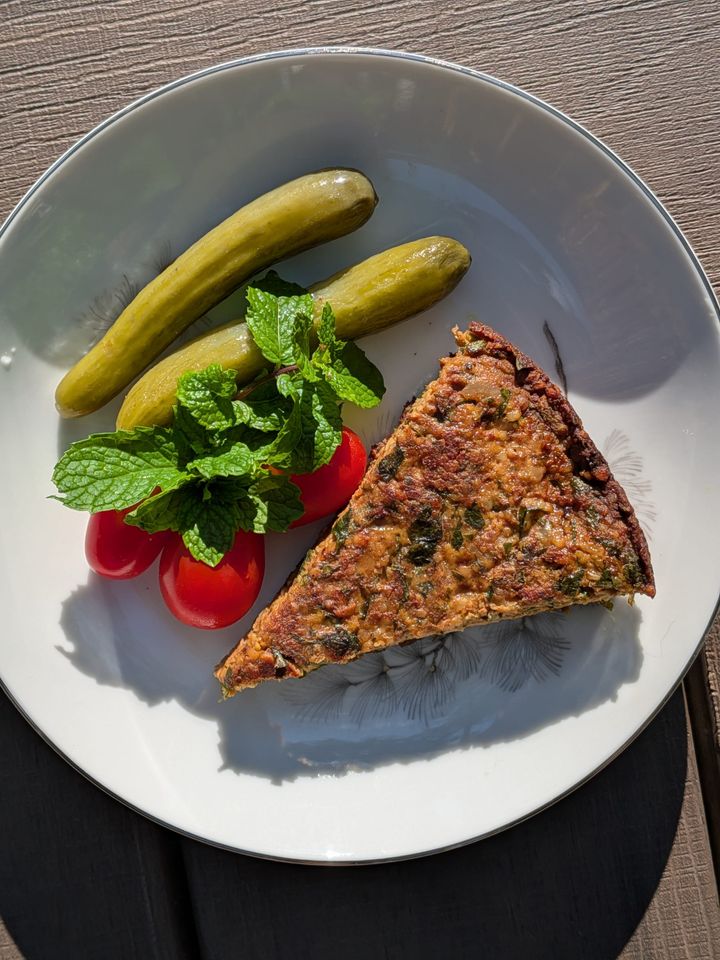
Kūkū-ye Sabzī [Herb Frittata]
A vibrant green frittata distinguished by a massive quantity of fresh herbs, symbolizing rebirth and spring. It’s a dense, deeply flavorful centerpiece that is traditionally pan-fried into thick wedges.

Classic Herb Frittata
Origin: Pan-Iranian Classic
Every spring, Kūkū-ye Sabzī has a place on the Nowrūz (Persian New Year) table, with deep green herbs representing rebirth and eggs symbolizing fertility. Refined into a walnut- and barberry-studded herb frittata by royal chefs in Qajar-era Tehran, it’s both a holiday tradition and an everyday staple served hot from the skillet or cold on the go. It’s especially great stuffed into flatbread with sliced tomatoes, brined pickles, and a squeeze of ketchup. (Incidentally, Persian fondness for the condiment starts naturally on kūkū, though Mojdeh takes it a step further by putting it on lasagna!)
Serves: 4
Preparation time: 15 minutes
Cooking time: 35 minutes
Ingredients
Fresh Produce
- 1 cup packed fresh flat-leaf parsley leaves
- 1 cup packed fresh cilantro leaves
- 1 cup packed fresh dill fronds
- 1 cup fresh chives or scallions
Dairy & Eggs
- 5 large eggs
Pantry
- ⅓ cup (1.5 oz / 40g) walnuts
- 2 tbsp dried barberries
- 1 tsp baking powder
- ½ tsp ground turmeric
- 1 tsp kosher salt
- ¼ tsp black pepper
- 2 tbsp neutral oil or olive oil
Preparation
- Pick through the dried barberries to remove any stems, then rinse briefly in cool water and pat dry.
- Wash the parsley, cilantro, dill, and chives or scallions thoroughly and spin or pat completely dry. Strip any tough stems and finely chop all the greens.
- Coarsely chop the walnuts.
Instructions
- Mix the batter. In a large bowl, whisk the 5 large eggs with 1 tsp baking powder, ½ tsp ground turmeric, 1 tsp kosher salt, and ¼ tsp black pepper until frothy and uniform. Add the chopped greens, chopped walnuts, and dried barberries, and fold until the greens are evenly coated.
- Cook the base. Warm 1½ tbsp of the oil in a medium nonstick skillet with a lid over medium heat. Pour the herb-and-egg mixture into the hot skillet and smooth the top into an even layer. Cover the skillet, reduce the heat to low, and cook for 18–20 minutes until the bottom is deep golden green and the center is set.
- Flip and finish. Brush or drizzle the remaining ½ tbsp oil over the top surface of the kūkū. Using a spatula, cut the kūkū into four equal wedges inside the pan and carefully flip each wedge over. Cover the skillet again and cook over low heat for 12–15 minutes more until the second side is golden and cooked through.
- Serve. Cut each wedge in half to make 8 pieces and arrange on a serving platter. Serve warm or at room temperature alongside flatbread, brined pickles, and sliced tomatoes.
Tips
- Ensure the washed herbs are completely dry before chopping; excess water clinging to the leaves will steam the batter and make the kūkū soggy rather than lofty and tender.
- For a hands-off oven method, pour the batter into a greased 8-inch (20 cm) baking dish and bake at 350°F (175°C) for 30–35 minutes until set in the center.


Comments ()